Amazing Bible Timeline With World History Pdf
Contents • • • • • • • • • • • • • • • • • • • • • • • • • • • • • • • • • • • • • • • • • • • • • • Etymology The English word is from the Latin biblia, from the same word in and and ultimately from τὰ βιβλία ta biblia 'the books' (singular βιβλίον biblion). Biblia is short for biblia sacra 'holy book', while biblia in Greek and Late Latin is neuter plural (gen. It gradually came to be regarded as a feminine singular noun ( biblia, gen. Bibliae) in medieval Latin, and so the word was loaned as a singular into the vernaculars of Western Europe.
Moses delivers words of Deuter- onomy. Joshua leads next generation of. Israelites into. Canaan (Josh. 299 years (see Book of Judges). David becomes king. (David's son) becomes king.

Latin biblia sacra 'holy books' translates Greek τὰ βιβλία τὰ ἅγια ta biblia ta hagia, 'the holy books'. The word βιβλίον itself had the literal meaning of 'paper' or 'scroll' and came to be used as the ordinary word for 'book'. It is the diminutive of βύβλος byblos, 'Egyptian papyrus', possibly so called from the name of the sea port (also known as Gebal) from whence Egyptian was exported to Greece. The Greek ta biblia (lit. 'little papyrus books') was 'an expression used to describe their sacred books (the ). Christian use of the term can be traced to c. The biblical scholar notes that appears to be the first writer (in his Homilies on Matthew, delivered between 386 and 388) to use the Greek phrase ta biblia ('the books') to describe both the Old and New Testaments together.
Saint Paul Writing His Epistles, 16th-century painting. Professor John K. Riches, at the University of Glasgow, says that 'the biblical texts themselves are the result of a creative dialogue between ancient traditions and different communities through the ages', and 'the biblical texts were produced over a period in which the living conditions of the writers – political, cultural, economic, and ecological – varied enormously'. Lim, a professor of Hebrew Bible and Second Temple Judaism at the, says that the is 'a collection of authoritative texts of apparently divine origin that went through a human process of writing and editing.' He states that it is not a magical book, nor was it literally written by and passed to mankind. Parallel to the solidification of the Hebrew canon (c. 3rd century BCE), only the Torah first and then the Tanakh began to be translated into Greek and expanded, now referred to as the or the Greek Old Testament.
In Christian Bibles, the New Testament Gospels were derived from oral traditions in the second half of the first century CE. Riches says that: Scholars have attempted to reconstruct something of the history of the oral traditions behind the Gospels, but the results have not been too encouraging. The period of transmission is short: less than 40 years passed between the death of Jesus and the writing of Mark's Gospel.
This means that there was little time for oral traditions to assume fixed form. The Bible was later translated into Latin and other languages. John Riches states that: The translation of the Bible into Latin marks the beginning of a parting of the ways between Western Latin-speaking Christianity and Eastern Christianity, which spoke Greek, Syriac, Coptic, Ethiopic, and other languages. The Bibles of the Eastern Churches vary considerably: the Ethiopic Orthodox canon includes 81 books and contains many apocalyptic texts, such as were found at Qumran and subsequently excluded from the Jewish canon. As a general rule, one can say that the Orthodox Churches generally follow the Septuagint in including more books in their Old Testaments than are in the Jewish canon.
Hebrew Bible. The (2nd century BCE) contains a portion of a pre-Masoretic Text, specifically the and the prayer. The is the authoritative text of the,.
It defines the books of the Jewish canon, and also the precise letter-text of these biblical books, with their and. The oldest extant manuscripts of the Masoretic Text date from approximately the 9th century CE, and the (once the oldest complete copy of the Masoretic Text, but now missing its section) dates from the 10th century. The name (: תנ'ך) reflects the threefold division of the Hebrew Scriptures, ('Teaching'), ('Prophets') and ('Writings'). Samaritan Inscription containing portion of the Bible in nine lines of Hebrew text, currently housed in the British Museum The Hebrew names of the books are derived from the in the respective texts.
The Torah consists of the following five books: •, Beresheeth (בראשית) •, Shemot (שמות) •, Vayikra (ויקרא) •, Bamidbar (במדבר) •, Devarim (דברים) The first eleven chapters of Genesis provide accounts of the (or ordering) of the world and the history of God's early relationship with humanity. The remaining thirty-nine chapters of Genesis provide an account of God's with the, and (also called ) and Jacob's children, the ', especially. It tells of how God commanded Abraham to leave his family and home in the city of, eventually to settle in the land of, and how the Children of Israel later moved to Egypt. The remaining four books of the Torah tell the story of, who lived hundreds of years after the patriarchs. He leads the Children of Israel from slavery in to the renewal of their covenant with God at and their wanderings in the desert until a new generation was ready to enter the land of Canaan. The Torah ends with the death of Moses. The Torah contains the commandments of God, revealed at Mount Sinai (although there is some debate among traditional scholars as to whether these were all written down at one time, or over a period of time during the 40 years of the wanderings in the desert, while several modern Jewish movements reject the idea of a literal revelation, and critical scholars believe that many of these laws developed later in Jewish history).
These commandments provide the basis for. Tradition states that there are ( taryag mitzvot). A page from the A Christian Bible is a set of books that a regards as and thus constituting. Although the primarily used the Septuagint or the among speakers, the did not leave a defined set of new scriptures; instead the canon of the New Testament.
Groups within Christianity include differing books as part of their sacred writings, most prominent among which are the biblical apocrypha or deuterocanonical books. Significant versions of the English Christian Bible include the, the, the, the, the, the, the, the, and the. Old Testament. Main article: The books which make up the Christian Old Testament differ between the Catholic (see ), Orthodox, and Protestant (see ) churches, with the Protestant movement accepting only those books contained in the Hebrew Bible, while Catholics and Orthodox have wider canons. A few groups consider particular translations to be divinely inspired, notably the Greek Septuagint and the Aramaic. [ ] Apocryphal or deuterocanonical books In, translations based on the Septuagint still prevail.
The Septuagint was generally abandoned in favour of the 10th-century Masoretic Text as the basis for translations of the Old Testament into languages. [ ] Some modern Western translations since the make use of the Septuagint to clarify passages in the Masoretic Text, where the Septuagint may preserve a variant reading of the Hebrew text. [ ] They also sometimes adopt variants that appear in other texts, e.g., those discovered among the. A number of books which are part of the or the Greek Septuagint but are not found in the Hebrew (Rabbinic) Bible (i.e., among the protocanonical books) are often referred to as deuterocanonical books by Roman Catholics referring to a later secondary (i.e., deutero) canon, that canon as fixed definitively by the 1545–1563. It includes 46 books for the Old Testament (45 if Jeremiah and Lamentations are counted as one) and 27 for the New. Most Protestants term these books as.
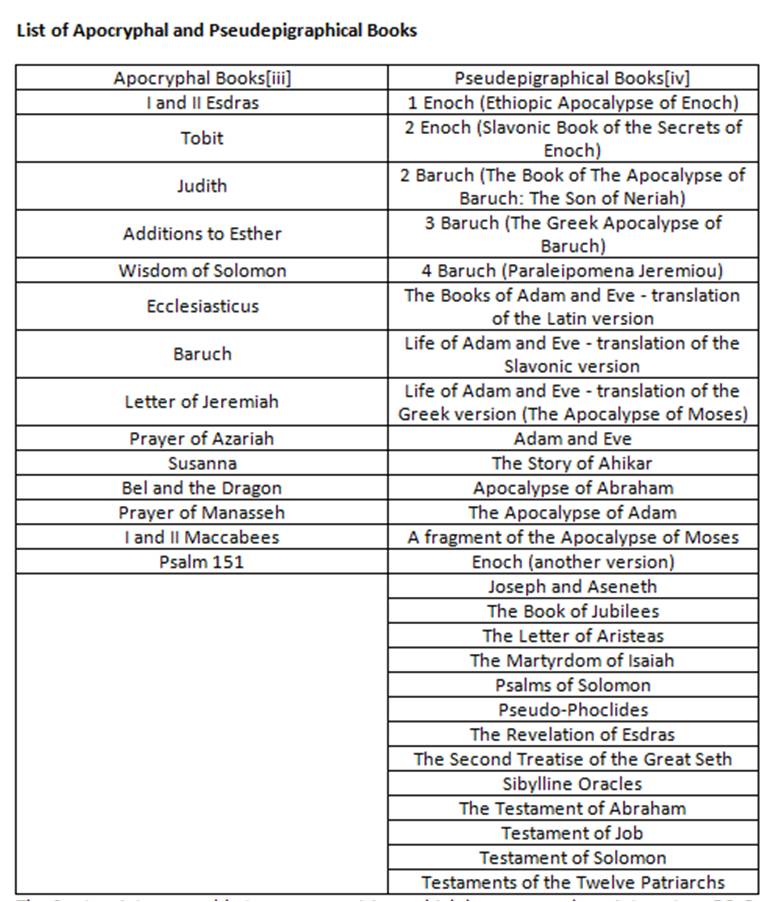
Modern traditions do not accept the deuterocanonical books as canonical, although Protestant Bibles included them in Apocrypha sections until the 1820s. However, Roman Catholic and Eastern Orthodox Churches include these books as part of their Old Testament. Main article: The term Pseudepigrapha commonly describes numerous works of Jewish religious literature written from about 300 BCE to 300 CE. Not all of these works are actually pseudepigraphical. It also refers to books of the New Testament canon whose authorship is misrepresented. The 'Old Testament' Pseudepigraphal works include the following: • • • • Ethiopic (1 Enoch) • Slavonic (2 Enoch) • Hebrew (3 Enoch) (also known as 'The Revelation of Metatron' or 'The Book of Rabbi Ishmael the High Priest') • • (2 Baruch) • (Letter to Philocrates regarding the translating of the Hebrew Scriptures into Greek) • • • • • (3 Baruch) • Book of Enoch Notable pseudepigraphal works include the Books of Enoch (such as,, surviving only in, and, surviving in, c.
5th to 6th century CE). These are ancient religious works, traditionally ascribed to the prophet, the great-grandfather of the patriarch. They are not part of the used by, apart from. Most Christian denominations and traditions may accept the Books of Enoch as having some historical or theological interest or significance. It has been observed that part of the Book of Enoch is quoted in the (part of the New Testament) but Christian denominations generally regard the Books of Enoch as non-canonical or non-inspired.
However, the Enoch books are treated as canonical by the and. The older sections (mainly in the Book of the Watchers) are estimated to date from about 300 BC, and the latest part (Book of Parables) probably was composed at the end of the 1st century BCE.
Denominational views of Pseudepigrapha There arose in some Protestant biblical scholarship an extended use of the term pseudepigrapha for works that appeared as though they ought to be part of the biblical canon, because of the authorship ascribed to them, but which stood outside both the recognized by Protestants and Catholics. These works were also outside the particular set of books that Roman Catholics called deuterocanonical and to which Protestants had generally applied the term Apocryphal. Accordingly, the term pseudepigraphical, as now used often among both Protestants and Roman Catholics (allegedly for the clarity it brings to the discussion), may make it difficult to discuss questions of pseudepigraphical authorship of canonical books dispassionately with a lay audience. To confuse the matter even more, Eastern Orthodox Christians accept books as canonical that Roman Catholics and most Protestant denominations consider pseudepigraphical or at best of much less authority. There exist also churches that reject some of the books that Roman Catholics, Orthodox and Protestants accept. The same is true of some. Many works that are 'apocryphal' are otherwise considered genuine.
Role of the Old Testament in Christian theology. Further information: and The Old Testament has always been central to the life of the Christian church.
Bible scholar says 'Jesus himself was profoundly shaped by the scriptures.' He adds that the earliest Christians also searched those same Hebrew scriptures in their effort to understand the earthly life of Jesus. They regarded the 'holy writings' of the Israelites as necessary and instructive for the Christian, as seen from Paul's words to Timothy (2 Timothy 3:15), and as pointing to the Messiah, and as having reached a climactic fulfillment in Jesus himself, generating the ' prophesied.
New Testament. Main article: The New Testament is the name given to the second and final portion of the Christian Bible. Is its central figure. The term 'New Testament' came into use in the second century during a controversy among Christians over whether or not the Hebrew Bible should be included with the Christian writings as sacred scripture. The New Testament presupposes the inspiration of the Old Testament.
Some other works which were widely read by early churches were excluded from the New Testament and relegated to the collections known as the (generally considered orthodox) and the New Testament (including both orthodox and heretical works). Most Christians consider the New Testament to be an infallible source of doctrine, while others go even farther to affirm that it is also inerrant, or completely correct in historical and factual details as well as theologically. In recent times, however, the authority of the New Testament books has been challenged. The school of historical criticism has exposed various apparent contradictions within the texts, as well as questions of authorship and dating.
The New Testament is a collection of 27 books of 4 different of Christian literature (, one account of the, and an ). These books can be grouped into. An early German translation. His translation of the text into the was highly influential. The original, that is, the original Greek writings and written by the original authors of the New Testament, have not survived.
But historically copies exist of those original autographs, transmitted and preserved in a number of. There have been some minor variations, additions or omissions, in some of the texts.
When ancient scribes copied earlier books, they sometimes wrote notes on the margins of the page ( ) to correct their text – especially if a scribe accidentally omitted a word or line – and to comment about the text. When later scribes were copying the copy, they were sometimes uncertain if a note was intended to be included as part of the text. Over time, different regions evolved different versions, each with its own assemblage of omissions and additions. The three main textual traditions of the Greek New Testament are sometimes called the (generally minimalist), the (generally maximalist), and the (occasionally wild). Together they comprise most of the ancient manuscripts. Development of the Christian canons.
(pictured) produced a 4th-century edition of the Bible, known as the, that became the Catholic Church's official translation. The Old Testament canon entered into Christian use in the Greek Septuagint translations and original books, and their differing lists of texts. In addition to the Septuagint, Christianity [ ] subsequently added various writings that would become the New Testament.
Somewhat different lists of accepted works continued to develop in antiquity. In the 4th century a series of produced a list of texts equal to the 39, 46, 51, or 54-book canon of the Old Testament and to the 27-book canon of the New Testament that would be subsequently used to today, most notably the in 393 CE. 400, produced a definitive Latin edition of the Bible (see ), the canon of which, at the insistence of the Pope, was in accord with the earlier Synods. With the benefit of hindsight it can be said that this process effectively set the New Testament canon, although there are examples of other canonical lists in use after this time. The Protestant Old Testament of today has a 39-book canon – the number of books (though not the content) varies from the Jewish Tanakh only because of a different method of division – while the Roman Catholic Church recognizes 46 books (51 books with some books combined into 46 books) as the canonical Old Testament.
The Eastern Orthodox Churches recognize 3 Maccabees, 1 Esdras, Prayer of Manasseh and Psalm 151 in addition to the Catholic canon. Some include 2 Esdras.
The Anglican Church also recognizes a longer canon. [ ] The term 'Hebrew Scriptures' is often used as being synonymous with the Protestant Old Testament, since the surviving scriptures in Hebrew include only those books, while Catholics and Orthodox include additional texts that have not survived in Hebrew. Both Catholics and Protestants (as well as Greek Orthodox) have the same 27-book New Testament Canon. The New Testament writers assumed the inspiration of the Old Testament, probably earliest stated in, 'All scripture is given by inspiration of God'. Ethiopian Orthodox canon.
Main article: The Canon of the is wider than the canons used by most other Christian churches. There are 81 books in the Ethiopian Orthodox Bible. The Ethiopian Old Testament Canon includes the books found in the accepted by other Orthodox Christians, in addition to and which are ancient Jewish books that only survived in but are quoted in the New Testament, [ ] also Greek Ezra and the, 3 books of, and at the end of the Psalter. The three books of Meqabyan are not to be confused with the books of Maccabees. The order of the other books is somewhat different from other groups', as well. The Old Testament follows the Septuagint order for the Minor Prophets rather than the Jewish order. [ ] Divine inspiration.
A Bible is placed centrally on a altar, highlighting its importance The Second Epistle to Timothy says that 'all scripture is given by inspiration of God, and is profitable for doctrine, for reproof, for correction, for instruction in righteousness'. ( ) Various related but distinguishable views on divine inspiration include: • the view of the Bible as the inspired word of God: the belief that God, through the, intervened and influenced the words, message, and collation of the Bible • the view that the Bible is also, and incapable of error in matters of faith and practice, but not necessarily in historic or scientific matters • the view that the Bible represents the, without error in any aspect, spoken by God and written down in its perfect form by humans Within these broad beliefs many schools of hermeneutics operate. 'Bible scholars claim that discussions about the Bible must be put into its context within church history and then into the context of contemporary culture.' Are associated [ ] with the doctrine of biblical literalism, where the Bible is not only inerrant, but the meaning of the text is clear to the average reader. Jewish antiquity attests to belief in sacred texts, and a similar belief emerges in the earliest of Christian writings. Various texts of the Bible mention divine agency in relation to its writings. In their book A General Introduction to the Bible, and William Nix write: 'The process of inspiration is a mystery of the providence of God, but the result of this process is a verbal, plenary, inerrant, and authoritative record.'
Most evangelical biblical scholars associate inspiration with only the original text; for example some American Protestants adhere to the 1978 which asserted that inspiration applied only to the text of Scripture. Among adherents of Biblical literalism, a minority, such as followers of the, extend the claim of inerrancy only to a particular translation. Versions and translations. Title page from the first translation of the Bible, 1588. (1545–1604) The original texts of the Tanakh were mainly in Hebrew, with some portions in Aramaic.
In addition to the authoritative Masoretic Text, Jews still refer to the Septuagint, the translation of the Hebrew Bible into Greek, and the, an Aramaic version of the Bible. There are several different ancient versions of the Tanakh in Hebrew, mostly differing by spelling, and the traditional Jewish version is based on the version known as Aleppo Codex. Even in this version there are words which are traditionally read differently from written, because the oral tradition is considered more fundamental than the written one, and presumably mistakes had been made in copying the text over the generations. [ ] The primary biblical text for early Christians was the Septuagint. In addition, they translated the Hebrew Bible into several other languages. Translations were made into Syriac,,, and Latin, among other languages.
The Latin translations were historically the most important for the Church in the West, while the Greek-speaking East continued to use the Septuagint translations of the Old Testament and had no need to translate the New Testament. The earliest Latin translation was the text, or, which, from internal evidence, seems to have been made by several authors over a period of time. Psp Homebrew Game Pack Download.
It was based on the Septuagint, and thus included books not in the Hebrew Bible. According to the Latin (also known as the Gelasian Decree), thought to be of a 6th-century document of uncertain authorship and of pseudepigraphal papal authority (variously ascribed to,, or ) but reflecting the views of the Roman Church by that period, the in 382 AD under Pope Damasus I (366–383) assembled a list of books of the Bible.
Damasus commissioned Saint to produce a reliable and consistent text by translating the original Greek and Hebrew texts into Latin. This translation became known as the, in the fourth century AD (although Jerome expressed in his prologues to most books that they were non-). In 1546, at the, Jerome's Vulgate translation was declared by the Roman Catholic Church to be the only authentic and official Bible in the. Since the, for many languages have been made.
The Bible continues to be translated to new languages, largely by Christian organizations such as, and. Main articles: and In the 17th century collected the current evidence to conclude outright that Moses could not have written the bulk of the Torah. Shortly afterwards the philosopher published a unified critical analysis, arguing that the problematic passages were not isolated cases that could be explained away one by one, but pervasive throughout the five books, concluding that it was 'clearer than the sun at noon that the Pentateuch was not written by Moses...'
Archaeological and historical research. Main articles: and Biblical archaeology is the that relates to and sheds light upon the Hebrew Scriptures and the Christian Greek Scriptures (or the 'New Testament').
It is used to help determine the lifestyle and practices of people living in biblical times. There are a wide range of interpretations in the field of biblical archaeology.
One broad division includes which generally takes the view that most of the Old Testament or the is based on history although it is presented through the religious viewpoint of its time. It is considered to be the opposite of which considers the Bible to be a purely (5th century BCE and later) composition. Even among those scholars who adhere to biblical minimalism, the Bible is a historical document containing first-hand information on the and, and there is universal scholarly consensus that the events of the 6th century BCE have a basis in history. The historicity of the biblical account of the of the 10th to 7th centuries BCE is disputed in scholarship.
The biblical account of the 8th to 7th centuries BCE is widely, but not universally, accepted as historical, while the verdict on the earliest period of the (10th century BCE) and the is unclear. Archaeological evidence providing information on this period, such as the, can potentially be decisive. The biblical account of events of the in the, and the migration to the and the period of are not considered historical in scholarship. Bible Museum Bible Museums of the United States 1) On December 1, 2017, the opened in Washington D.C. The museum was said to be built for all guests to understand and appreciate the existence of the Bible.Furthermore, the museum seeks to disperse historical information regarding the Bible as well as portray the significance of the Bible in a neutral way. 2) Durham Bible Museum: The Durham Bible Museum is located in Houston Texas and is known for the collection of rare Bibles around the world. Furthermore, the Durham Museum is known to have many different Bibles of various languages.
Image gallery • Bibles •. Shelves of the Bizzell Bible Collection at Illustrations Most old Bibles were illuminated, they were in which the is supplemented by the addition of decoration, such as decorated, borders () and. Up to the twelfth century, most manuscripts were produced in monasteries in order to add to the library or after receiving a from a wealthy patron. Larger monasteries often contained separate areas for the who specialized in the production of manuscripts called a, where 'separate little rooms were assigned to book copying; they were situated in such a way that each scribe had to himself a window open to the cloister walk.' By the fourteenth century, the of monks writing in the scriptorium started to employ laybrothers from the urban scriptoria, especially in Paris, Rome and the Netherlands.
Demand for manuscripts grew to an extent that the Monastic libraries were unable to meet with the demand, and began employing secular scribes and illuminators. These individuals often lived close to the monastery and, in certain instances, dressed as monks whenever they entered the monastery, but were allowed to leave at the end of the day. The manuscript was 'sent to the, who added (in red or other colours) the titles,, the initials of chapters and sections, the notes and so on; and then – if the book was to be illustrated – it was sent to the illuminator.' In the case of manuscripts that were sold commercially, the writing would 'undoubtedly have been discussed initially between the patron and the scribe (or the scribe's agent,) but by the time that the written gathering were sent off to the illuminator there was no longer any scope for innovation.' • Bible illustrations •. The Canon of Scripture.
Downers Grove, Illinois: IVP Academic. • De Hamel, Christopher (1992). Medieval Craftsmen: Scribes and Illuminations. Buffalo: University of Toronto. • Henshaw, T.
The Writings: The Third Division of the Old Testament Canon. George Allen & Unwin Ltd. • Riches, John (2000). The Bible: A Very Short Introduction. Oxford: Oxford University Press.. • Wright, N.T.
The Last Word: Scripture and the Authority of God – Getting Beyond the Bible Wars. Further reading. • Understanding the Old Testament..
New York: Avenel Books, 1981.. Oxford University Press, 2003.. • Bible, Authorized Version. The New Cambridge Paragraph Bible, with the Apocrypha, King James Version, ed. By David Norton. Cambridge, Eng.: Cambridge University Press, 2005.
N.B.: This is a critically reconstructed text of the Authorized 'King James' Bible with its entire contents (including all of its marginalia, fore-matter, the Apocrypha, etc.), as close to the original translators' intentions and wording as possible at the time of this edition, with spelling modernized according to current Commonwealth usage. •,, and, eds. The New Jerome Biblical Commentary. New Jersey: Prentice Hall.. • Finkelstein, Israel; Silberman, Neil Asher (August 2002).
'Review: 'The Bible Unearthed': A Rejoinder'. Bulletin of the American Schools of Oriental Research. • (29 October 1999)... Archived from on 21 December 2008. • (March–April 2007).
Biblical Archaeology Review. • Misquoting Jesus: The Story Behind Who Changed the Bible and Why New York: HarperSanFrancisco, 2005.. The Absolute Beginner's Guide to the Bible. Indianapolis: Que Publishing, 2005. New York University Press, 2004.
• Hotchkiss, Gregory K. The Middle Way: Reflections on Scripture and Tradition, in series, Reformed Episcopal Pamphlets, no. Media, Penn.: Reformed Episcopal Publication Society, 1985. N.B.: Place of publication also given as Philadelphia, Penn.; the approach to the issue is from an evangelical Anglican (Reformed Episcopal Church) orientation. Without ISBN • Lienhard, Joseph T. The Bible, The Church, and Authority. Collegeville, Minnesota: Liturgical Press, 1995.
The Battle for the Bible. Zondervan Publishing House, 1978. •, The Bible and Zionism: Invented Traditions, Archaeology and Post-Colonialism in Palestine-Israel. London, Zed Books, 2007. • McDonald, Lee M.
The Canon Debate. Hendrickson Publishers (1 January 2002).
• Miller, John W. The Origins of the Bible: Rethinking Canon History Mahwah, New Jersey: Paulist Press, 1994..
• Roper, J.C., Bp., et al. Cygwin Full Install Disk Space. Toronto: Musson Book Co., 1924. In series, 'The Layman's Library of Practical Religion, Church of England in Canada', vol.
N.B.: Series statement given here in the more extended form of it on the book's front cover. The Manga Bible: From Genesis to Revelation. Galilee Trade (15 January 2008). • Taylor, Hawley O. 'Mathematics and Prophecy.' Modern Science and Christian Faith. Wheaton: Van Kampen, 1948, pp. 175–83.
• Wycliffe Bible Encyclopedia, 'Book of Ezekiel', p. 580 and 'prophecy', p. 1410. Chicago: Moody Bible Press, 1986.
Rabbi Ken Spiro, originally from New Rochelle, NY, graduated from Vassar College with a BA in Russian Language and Literature and did graduate studies at the Pushkin Institute in Moscow. He has rabbinic ordination from Aish Jerusalem and a Masters Degree in History from Vermont College of Norwich University.
Rabbi Spiro is also a licensed tour guide by the Israel Ministry of Tourism. He has appeared on numerous radio and TV programs such as BBC, National Geographic Channel and The History Channel. He lives near Jerusalem with his wife and five children, where he works as a senior lecturer for Aish Jerusalem.
Crash Course in Jewish History is 'a comprehensive, thoughtful and highly educational survey of Jewish history.” - Sir Martin Gilbert In one volume, Crash Course in Jewish History explores the 4,000 years of Jewish existence while answering the great questions: Why have the Jewish people been so unique, so impactful, yet so hated and so relentlessly persecuted? Crash Course in Jewish History is not only comprehensive and readable, it is also entertaining and enlightening. Novices and scholars alike will find Crash Course in Jewish History to be thought-provoking and insightful, as well as a valuable and relevant guide to understanding the challenges we all face in the 21 st century. I am so impressed by the engaging, historical lessons given here. I am planning to go to a synagogue for the first time in my life this evening, God-willing. So, I am trying to gain some perspective on the history leading up to the current, world-wide worship of the LORD of Israel (so diverse and yet so unchanged, in some respects), since he is also my God.
There is a possibility that I have Jewish ancestors, and so I find this information very relevant and whether that proves to be the case or not, I will always see it as a part of my own history. I can't stop reading, it is so fascinating.thanks so much for compiling and sharing this! At this point, with the Temple destroyed and the bulk - not all - of the Jewish people about to go into exile, it is appropriate to offer congratulations to Rabbi Spiro for providing a 'potted history' which never descends into triteness or oversimplification. Now that we have left the 'Biblical' phase of Jewish history (not forgetting, though, Biblical prophecies of the return of The People to The Land), I'm looking forward to the rabbi's use of 'secular' and, no doubt, rabbinical sources to deal with the 2,000 years still to come. Thanks a lot; I don't know what I'm going to do when the series ends and there is no weekly edition of Rabbi Ken's History. Phil Kruse, Australia.
Seasons Greetings? Do you wish someone 'Happy Chanukah' in the same way you wish someone 'Merry Xmas'? I have met some Jewish friends on my travels, and I wish to send them seasons greetings. But I'm unsure what to write. The Aish Rabbi Replies: If you'd like to send your Jewish friends greeting cards, they should say 'Happy Holidays' or 'Happy Chanukah' - but not the name of other holidays like Xmas, Ramadan or Kwanzaa.
To make your life easier, many Jewish sites provide free, online holiday greeting cards. Set Meaningful Goals Lack of meaningful goals in life can lead to sadness. If you do not find meaning in what you are doing, you are likely to feel unhappy.
To solve this, ask yourself what goals you can set that to you would be meaningful. The goals need not be major ones. Even a temporary minor goal is better than none at all. Make a list of goals to strive for. Be as specific as possible. Vague goals are not very motivating. Write down the major areas of your life and set goals in each of these areas: spiritual goals, interpersonal goals, self-improvement goals, etc.
Tevet 5 If one person does more and another does less, they are both equal before God if they have sincerely dedicated themselves to Him (Berachos 5b). All that can be asked of people is to do whatever is within their means.
No one is expected to do more than one can, but by the same token, anyone who does less than that is derelict. For example, people of meager means who give a small amount of money are considered to have performed that mitzvah satisfactorily if they have given whatever they can, whereas wealthy people who give a thousand times that much but could have given more are considered derelict in their performance of this mitzvah. The key to proper fulfillment of a mitzvah is dedication. One who performs a mitzvah perfunctorily may seek to get away with the bare minimum required for its fulfillment, whereas someone who is dedicated will invest himself in the mitzvah to the very maximum.
This dedication must be to God. While it is praiseworthy to dedicate oneself to the community or to friends, the recipients of one's benevolent actions may be so grateful to the benefactor that the latter may get carried away by this outpouring of gratitude, and believe that one has done enough. The only true judge of how much one can and should do is God; hence, it is only a sincere dedication to God that can lead one to perform mitzvos to the fullest of one's capacities. Today I shall. Try to sincerely fulfill my obligations toward God and toward my fellow man by doing the utmost within my means. With stories and insights, Rabbi Twerski's new book Twerski on Machzor makes Rosh Hashanah prayers more meaningful.
How to change the way we feel by changing the way we think. It’s surprising how many innocent people confess to crimes they didn’t commit. This can’t happen in Jewish law.
The origin and meaning of some of the most common Jewish names for girls. An expensive coffin is a distraction. Our love is not measured by how much money we spend on the casket. An interview with Prof. Andrew Porwancher, a history professor at Oklahoma University, who thinks the founding father was, in fact, a Jew.