Examples Of Activity Cost Pools And Cost Drivers
In, to identify cost drivers is very necessary for unit cost and total cost. We know that activity-based costing is based on the concept that products consume activities and activities consume resources. From activity pools, we can find cost drivers. Suppose, a company wants to produce several products. At that time, what will company do for calculating per unit cost? Just adding of raw material and labor cost and absorbing production overheads on direct labour hours or machine hours is not good way. There will be many activities where we have to spent money. All these activities will become cost drivers.
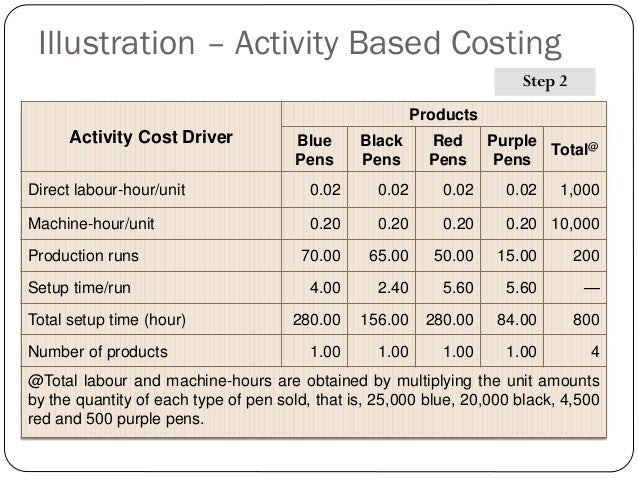
Examples of these cost drivers are given below: 1st: No. Of Purchase Orders When we have to make any product, we issue the order. This is a simple activity. Its cost can be calculated one the basis of no. Of purchase orders. So, number of purchase order is an example of cost driver. Of Set Up of Machine Setting up the machine is an activity of production.
Cost drivers are used for those costs that cannot be directly allocated. Costs attributed to Support cost pools use cost drivers to attribute their costs to activity cost pools. For example, estates costs would be assigned to an estates cost pool and would be attributed to academic departments and activities on the basis of space.
This activity will also consume certain expenses. To know machine set up rate, we need a cost driver. Of set up will be cost driver. With this, we can calculate set up of machine overhead rate per set up of the machine for production. Of Machine Hours No. Of Machine hours is different cost driver which can be used for calculating machine hour rate relating to depreciation, repair and maintenance of machines.
Of Parts or Weight of Material Handled Suppose, a company is making 4 products. These 4 products need 16 parts to assemble with each other. Different expenses may be spent for this activity.
We can calculate rate of this overhead on the basis of no. So, number of parts is a cost driver. Of Test or No. Of Inspections When any product is made, it is test for checking its quality. Specific experts are appointed for this. They consume money in the form of salary, electricity, travel and other depreciation of their specific equipments. Now, we need to calculate rate of these type of overheads.
It can be calculated on the basis of no. So, number of test is cost driver. Suppose, we need 5 test per unit of A product and suppose we have made 1000 units.
It means, we need 5000 tests for these units. If the accounts of inspection and test departments show the total cost Rs. We can calculate rate of per unit test. = 1,00,000 / 5000 = Rs. 20 per unit test 6th: No.
Of Direct Labour Hours No. Of direct labour hours is that cost driver which can be used for calculating supervising cost per unit. Of Batches of Material For calculating, storage cost per batch, we have to make a cost driver that will be no. Of batches of material.
Of Machine Operators No. Of machine operators is better cost driver for calculating electricity rate per machine operation. Above are just examples of cost drivers which are used but you can also different cost drivers which may be appropriate for calculating overhead cost of products under ABC method. Access account accountant Accounting accounting definitions accounting ebook Accounting education accounting procedure accounting process outsourcing Accounting Software advance advertising africa Amalgamation amendments announcements Annuity assets audit auditing Australia B.Com. Not found any lecture VIEW ALL Readmore Reply Cancel reply Delete By Home PAGES Lectures View All RECOMMENDED FOR YOU Category ARCHIVE SEARCH ALL Lectures Not found any lecture match with your request, please help to write it and send it to our email at vinod@svtuition.org for making this website free accounting and finance encyclopedia. Back Home Sunday Monday Tuesday Wednesday Thursday Friday Saturday Sun Mon Tue Wed Thu Fri Sat January February March April May June July August September October November December Jan Feb Mar Apr May Jun Jul Aug Sep Oct Nov Dec just now 1 minute ago $$1$$ minutes ago 1 hour ago $$1$$ hours ago Yesterday $$1$$ days ago $$1$$ weeks ago more than 5 weeks ago Followers Follow THIS CONTENT IS PREMIUM Please share to unlock.
Activity-based costing is a more precise way to allocate costs to cost objects. Plantwide rates are the easiest to apply but can cause cost distortion because all overhead resources are treated as though they are equally consumed by all cost objects. Departmental rates were more refined because at least we were breaking costs down by department and applying overhead based on the actual activity a cost object used in each department. ABC goes one step further.
Rather than just looking at each department, with ABC we are breaking down activities within the production process and calculating a rate for each activity. This allows a very refined allocation of overhead to the cost objects. In order to use ABC, we first must identify the activities that make up the processes important to our cost object.
It is important to note that ABC can be used by any type of business. Even service companies can benefit from using ABC, especially in competitive markets. Activities could include things like machine setup, inspecting, packaging, sending statements, and providing technical support. Once the company has identified the activities, the company should identify the estimated cost of each of these activities. The cost of each activity is called an activity cost pool. These cost pools are used to accumulate costs associated with each activity. Next, select an allocation base or activity that best acts as a driver for each activity cost pool.
If machine set up is one of your activity cost pools, the allocation base could be the number of setups that will be done over the year. For inspections, it makes sense to use the number of inspections that are done.
For packaging, we could use the number of items to be packaged or the cubic feet of product to be packaged. Sending statements would be based on the number of statements sent.
Technical support could be based on the number of calls received by tech support or on time. Now that you have your allocation bases set for each activity, estimate the quantity for each allocation base. Video Codec Download For Windows Media Player. The next step is to calculate the rate for each activity, using the estimated cost of each activity cost pool and the estimated quantity for each allocation base. At this point, this should start to look familiar because we did this using and. To calculate the ABC rate: Total estimated activity cost pool / Total estimated activity allocation base = ABC rate This is the exact same formula we used for plantwide rates and departmental rates. Total cost divided by total activity equals rate.
The only thing that is different about ABC rates is that you will have more of them. With plantwide rates we had one rate for the entire company. For departmental rates, we had one for each department. For ABC, we will have one rate for each activity that has been identified. It is extremely important to label each of your rates. If you are calculating the rate for machine setups, label your rate “$/setup”.
This makes it much easier when you are applying your rates. Backpack Writing Faigley Pdf Printer. Don’t skip this step. When students make mistakes, the mistakes are made in the application of the rates because students use the wrong driver to apply the rates. When you label your rates, it is so much easier to apply the rates because you don’t need to think about which rates to use for each activity.
If the problem states that there are 15 setups, look at your rates for the one that is marked “$/setup” and use that one. To apply the rates, multiply the actual amount of activity by the rate for that activity. Again, that is very similar to what we did for plantwide rates and departmental rates. Just like departmental rates, once you get the amount for each activity, you will need to add up the applied cost for each activity to get the total overhead applied to your cost object. Steps for using Activity-Based Costing • Identify the activities that are associated with your cost object and allocate estimated costs to each of the activities using an activity cost pool.
• Identify the allocation base for each of your activities and estimate the quantity for each allocation base. • Calculate the rate for each activity: estimated activity cost pool / estimated activity allocation base. • Apply the ABC rates using actual quantity for each activity.
• Add the cost of all your activities to calculate the total overhead cost for your cost object. Related Videos Activity-Based Costing – Allocating Cost to Cost Pools Activity-Based Costing – Calculating activity rates and applying rates.